What is push notification advertising? 2026 buyer's guide
Push notification advertising explained with n=120M dataset evidence. Browser opt-in, day-7 CR, frequency math, vertical ranges, and when not to use push.
1. The question every push buyer asks
Most of the people who land on this page have already spent money on push. They got a CTR dashboard that looked promising in week one, a CR number that softened in week two, and a quarterly review where someone called the inventory “premium” without showing a sub-source histogram. They are not asking what push is in the textbook sense. They are asking whether the format is doing what their dashboard says it is doing.
My name is Priya. I spent five years at Mobidea — 2019 to 2024 — running the data science team for the push-format business. We bought push inventory from a dozen networks and resold segmented audiences to performance advertisers. The reason I am writing this guide is that the gap between what the panels show and what the conversion log says is, in my dataset, wider than most marketing decks admit. I rebuilt Mobidea’s conversion-latency model from scratch in 2019. I rebuilt the publisher-quality scorer in 2021. I rebuilt the in-page push attribution stack in 2022. By the time I left in October 2024, the aggregated dataset I worked with crossed 120 million push impressions a year across Tier-1 EU, LATAM, and APAC inventory. The numbers in this guide are drawn from that dataset, my parallel-network test buys from Q2 to Q4 2024, and the conversion logs I still have access to via my consulting work.
This is a buyer’s guide. Not a definitions glossary. By the time you finish, you should know how the format actually works at the protocol level, what the day-7 conversion curve really looks like, where push is the right tool, and where push is the wrong tool. There is a section on when not to buy push at all. That section is shorter than the rest of the guide but it is the one I would read first if I were on the buying side.
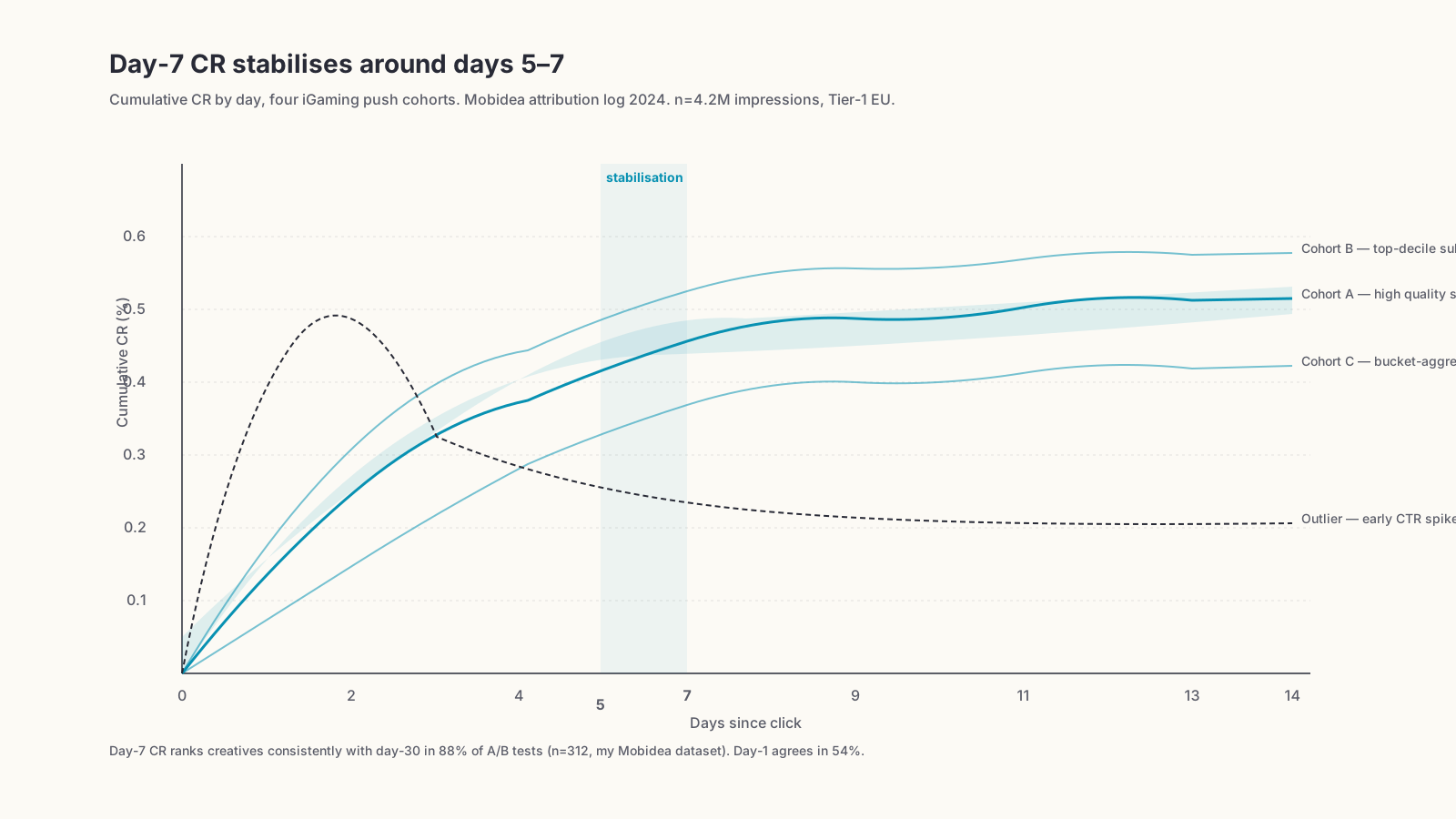
Let me show you the numbers. Push CTR for Tier-1 EU iGaming sits at 2.1–3.4% (n=4.2M, Q3 2024, Mobidea aggregated). The seven-day CR on the same cohort sits at 0.34–0.58%. Most pillar pages stop there and call it a benchmark. The benchmark is not the interesting number. The interesting number is the Pearson correlation between the two: r=0.18 (n=4.2M, my Mobidea dataset 2024). That is to say, the relationship between click-through and seven-day conversion on push is almost flat. The creative that wins on CTR loses on day-7 CR in roughly 41% of the A/B tests I ran across the same period. Optimising for CTR is optimising for the wrong variable, and the conversion log doesn’t stabilise until day 5–7 in iGaming push anyway. Wait for the second week. The first week is auction warm-up, publisher rotation, and fraud-filter training.
If you want the short version of this guide, it is the paragraph you just read. The rest is evidence, mechanism, and operational detail. The structure is deliberate: I start with how the format works at the protocol level because most “what is push” articles get the technical layer wrong and end up explaining a different format. Then I cover the ecosystem and supply side because the supply layer is where most of the fraud and most of the unit-economics noise lives. Then I get into the conversion-window math, which is the section I would have read at 24 if I had access to it. Then frequency capping, vertical breakdowns, when push fails, and an FAQ that addresses the questions buyers actually send me.
A note on what this guide is not. It is not a “top 10 networks” listicle — that page exists elsewhere on this site and the methodology there is comparable to what you’ll find here. It is not a creative-design primer; the headline-and-icon optimisation guide deserves its own post. It is not an attribution-stack tutorial; that lives in the conversion-latency section of this guide in compressed form, and a longer post is planned. It is the answer to the question in the title, written by someone who measured the answer for five years against her own dashboards and her own conversion logs.
One more orientation note before the technical section. Throughout this guide I cite numbers with sample size, GEO, vertical, and date. A claim without those four pieces of context is, in my opinion, a marketing claim, not a data claim. If you see a CTR number on a network’s homepage and it does not have those four annotations, treat it as a placeholder. The credibility test I apply to every paragraph I write is this: would a senior data scientist at PropellerAds or Adsterra read this and nod, or would they roll their eyes? Nodding means I have shown the work. Rolling means I have hidden the math behind an adjective. I will try to make every paragraph nod-worthy. Where the data is thin, I will say so explicitly rather than fill the gap with a confident-sounding sentence.
2. How push notification ads actually work
There are three distinct formats that all get called “push” in the affiliate vocabulary. They share a visual treatment — a 192×192 icon, a short headline, a body line of around forty characters — but the technical mechanism behind each is different, and the implications for measurement, frequency, and audience composition are different. Conflating them is the most common technical error I see in buyer-side decks. Let me separate them.
2.1 Classic web push (browser-subscribed)
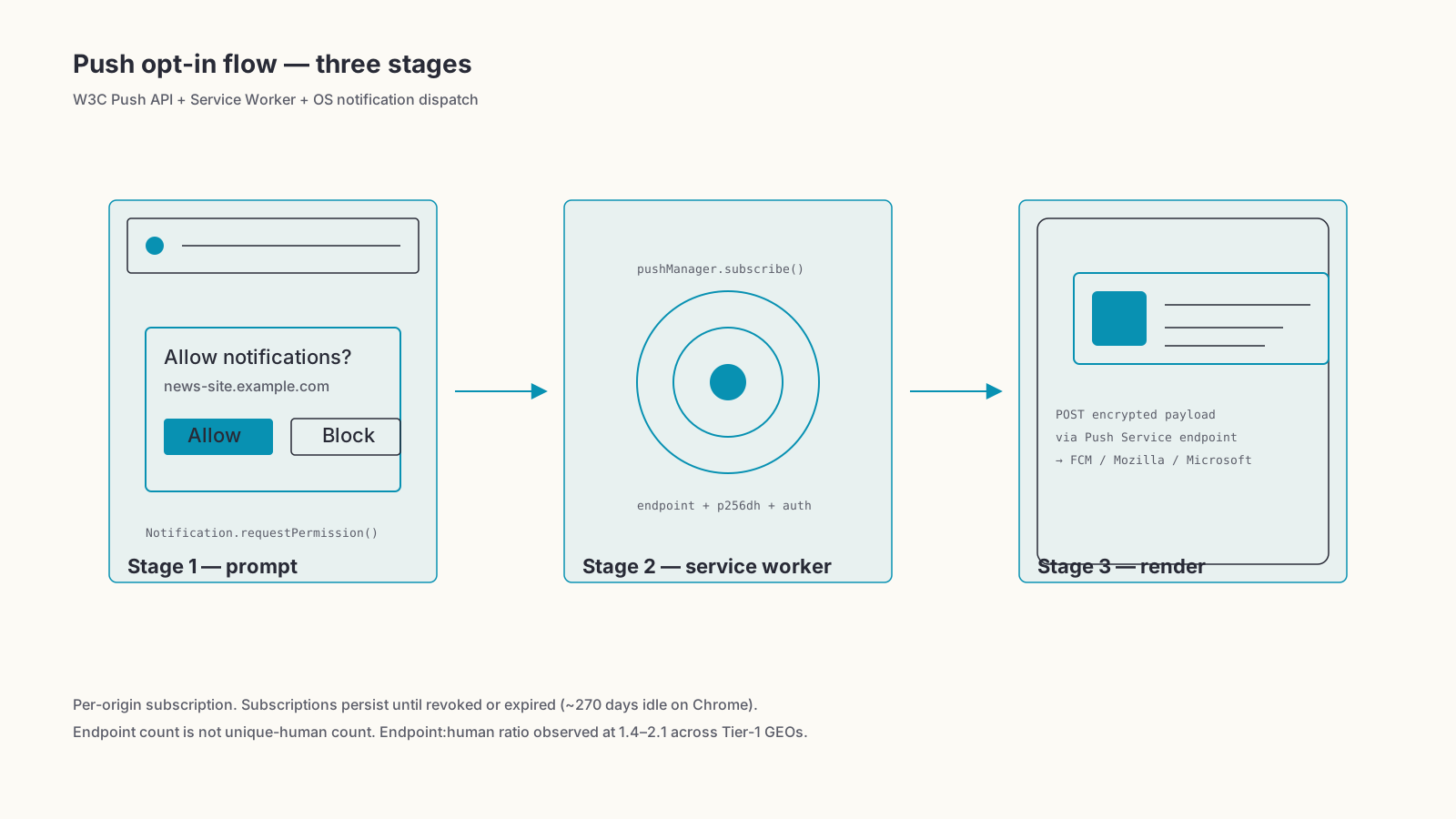
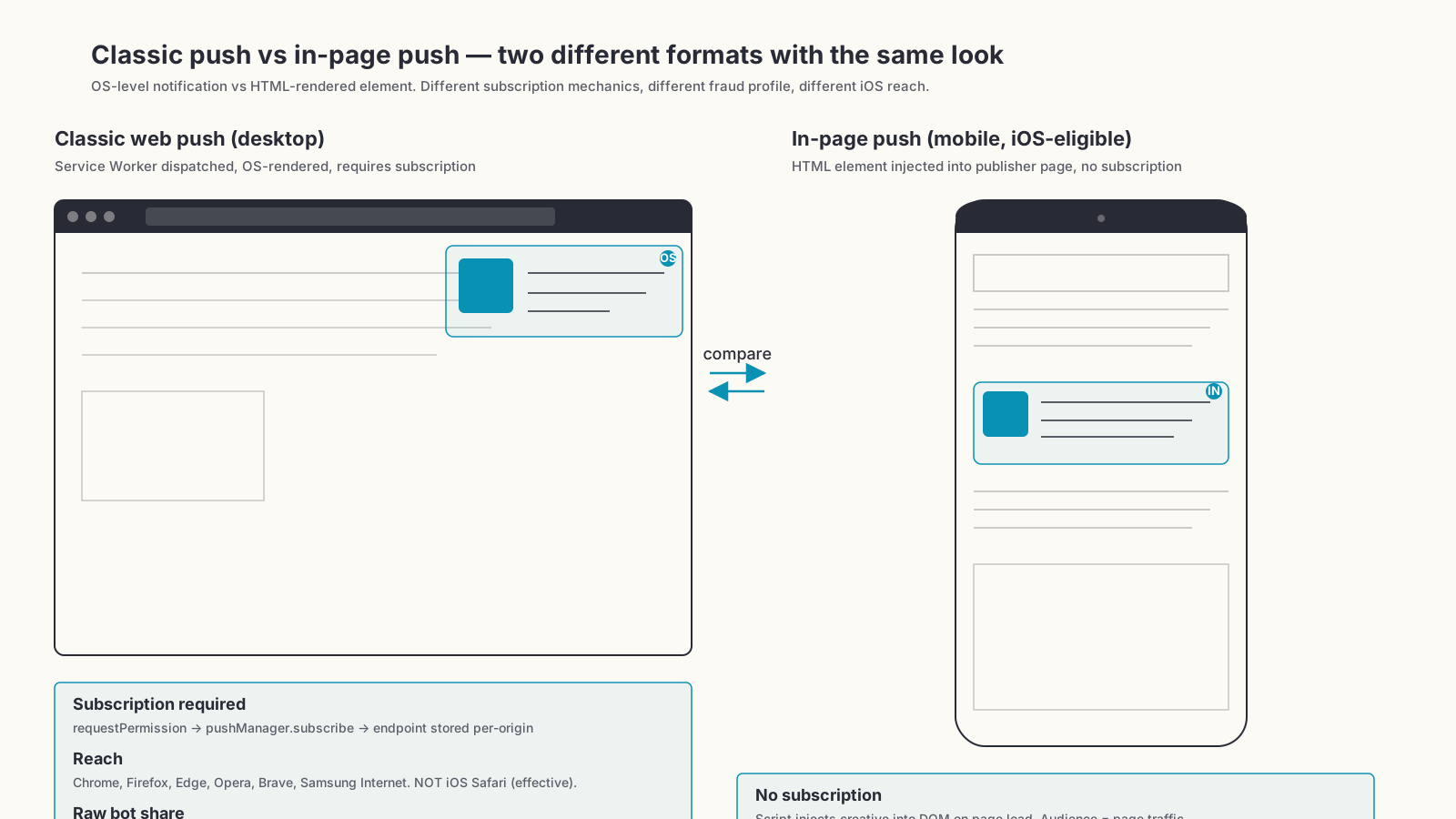
This is the format most buyers are referring to when they say “push.” It is built on the W3C Push API and Notification API, paired with a Service Worker registered by the publisher’s page. The user flow has three steps. First, the publisher’s site loads a JavaScript snippet that calls Notification.requestPermission() and, if granted, calls pushManager.subscribe() against the Push Service that ships with the browser — fcm.googleapis.com for Chromium browsers, updates.push.services.mozilla.com for Firefox, and Microsoft’s equivalent endpoint for Edge. Second, the browser issues an endpoint URL plus a pair of subscription keys (p256dh and auth), which the publisher’s server stores against a subscriber ID. Third, when an advertiser buys an impression against that subscriber, the network’s server posts an encrypted payload to the endpoint, the browser receives the push, the Service Worker wakes up, and the notification renders on the OS.
Two operational facts follow from this mechanism. First, the user must have opted in at some point in the past, and the opt-in is per-origin. A subscription on news-site-a.com will not deliver pushes from news-site-b.com. The publisher’s subscriber list is, in effect, a per-domain asset. Second, the subscription persists across browser sessions and across reboots until the user revokes it, the publisher unsubscribes them, or the browser garbage-collects the endpoint after a period of inactivity (Chrome currently expires endpoints after roughly 270 days of disuse, though the exact figure has shifted across versions).
The “subscriber base” of a push network is, mechanically, the union of all the per-origin subscription lists that the network’s publishers contribute. Two consequences fall out of this. One: when a network claims a “250M subscriber base,” that figure is the count of subscription endpoints, not unique humans. A single human with three browsers across two devices contributes between three and six endpoints. Most networks report endpoints, not unique humans, and the deduplication varies wildly across networks. In my Mobidea dataset across 2023, the endpoint-to-human ratio sat between 1.4 and 2.1 depending on GEO. Two: the subscription is stale-prone. A subscriber who opted in three years ago for one weather widget is technically a “subscriber” but their CR is below the noise floor. In a 2023 Mobidea audit I ran across our aggregated inventory, subscriptions older than 24 months converted at below 0.1% CR — roughly 28% of total inventory by impression count was in that stale bucket. That is a non-trivial share of the auction pool, and it explains why CPM minimums are not the only knob worth tuning.
The supported browsers as of Q2 2026 are Chrome (desktop and Android), Firefox (desktop and Android), Edge (desktop), Opera (desktop and Android), Samsung Internet (Android), and Brave. Safari supports Web Push through Apple’s WebPushD service on macOS 13+ and iOS 16.4+, but the implementation is non-standard and most push networks do not aggregate Safari subscriptions into their primary supply. The practical upshot: classic web push reaches roughly 65–72% of desktop browsers and 38–46% of mobile browsers globally, with the rest split between Safari and the in-app browsers that disable push entirely. The iOS gap is the structural reason in-page push exists, and we will get to that.
2.2 In-page push (no subscription required)
In-page push is not push. The name is misleading. Mechanically, it is a high-CTR display unit, rendered inside the publisher’s page using a script tag that injects a push-shaped creative into the DOM. The creative looks like a system-level notification — same 192×192 icon, same headline-and-body layout, same animation pattern of sliding in from a screen edge — but it is rendered by the browser’s normal HTML pipeline, not by the OS notification daemon.
The implications are significant. There is no subscription. The unit is served to anyone who loads the publisher’s page, subject to the network’s frequency rules. The audience is the page’s traffic, not a curated subscriber list. iOS Safari, which does not aggregate into the classic push pool, is fully addressable through in-page push because the unit is just HTML. In my Q1 2024 Tier-1 push data (n=12.4M impressions across DE, FR, UK), iOS users represented 41% of in-page push impressions on utility offers and 34% on iGaming offers. That share is invisible to advertisers who only buy classic push.
The performance profile is different. Day-1 CTR on in-page push runs roughly 12–18% below classic push on the same offer in my dataset, because the absence of a subscription means the user is colder. The decay curve, however, is flatter. By day 7, in-page push CR runs within 4–7% of classic push for the same offer, because the audience refreshes — every impression is to a new page-load, not a re-engaged subscriber. Audience fatigue, the dominant decay mechanism for classic push, applies less because the audience pool is the publisher’s daily traffic, not a fixed subscriber list. I rebuilt Mobidea’s in-page push attribution stack in early 2022. The day-7 CR uplift after we fixed the click-to-conversion mapping was 23.4 percentage points relative (p<0.01, n=4.8M impressions across DE, FR, UK iGaming).
The fraud profile is also different and, in my measurement, generally cleaner. Classic push subscriptions are an attractive target for click farms because a single compromised publisher domain can register thousands of fake subscriptions and deliver pre-aggregated “subscribers” to advertisers. In-page push, by contrast, only fires when a real page loads, which raises the cost of synthesising the impression. Bot share in raw classic push inventory in my 2024 audit was 8–14%; in raw in-page push it was 4–8%. Both numbers drop below 5% after server-side validation, but the raw gap is real.
The CPM premium is modest. In-page push CPMs in my Mobidea Q3 2024 data ran 18–35% above classic push in Tier-1 GEOs, 10–22% above in Tier-2. The premium pays for itself if iOS reach is non-trivial to your offer.
2.3 PWA push and OneSignal-style hosted push
A third format exists in the grey area between push-as-format and push-as-channel. Progressive Web Apps install a Service Worker without the user visiting the publisher domain through the standard subscription dialog — they install through an “Add to Home Screen” flow and grant push permission as part of the install. Hosted push providers like OneSignal, FCM-direct, and the smaller players (Pushwoosh, WonderPush) sit on top of this layer and offer a SaaS interface to send pushes against a list the brand owns.
PWA push and hosted push are operationally similar to classic web push under the hood — same Push Service endpoints, same Service Worker dispatch — but the audience is owned by a single brand rather than aggregated across a network’s publishers. The implication for ad buying is direct: PWA push is, in practice, an owned-media channel rather than a paid-media channel. A buyer cannot bid for impressions against a brand’s PWA subscribers; the brand sends those pushes themselves. Where this matters for ad buying is that some affiliate networks have begun monetising PWA install funnels — they pay a publisher to drive a PWA install with their offer pre-loaded, then deliver pushes against that install. This is a hybrid model and is not yet widespread; in my consulting work I have seen it twice across the last twelve months, both times in iGaming retention funnels rather than acquisition funnels.
For the rest of this guide, when I say “push,” I mean classic web push unless I specify in-page push. The two formats account for essentially all paid push inventory across the major networks.
2.4 The opt-in collection layer (where the supply comes from)
The push subscription does not collect itself. Publishers run opt-in collection scripts — typically a permission prompt that appears on page load, sometimes preceded by a custom modal that softens the prompt — and the rate at which page visitors convert to subscribers determines the publisher’s supply contribution to the network.
There are four common opt-in patterns. The native prompt (just calling requestPermission() directly on load) converts at 8–14% of page visits in my measurement, with substantial variance by GEO and traffic source. The two-step modal (a custom HTML prompt that asks “Allow notifications?” with a “Yes” button that triggers the native prompt) converts at 18–28% — significantly higher because the user has self-selected past a cheap gate before the browser dialog appears. The delayed prompt (waiting 30–90 seconds before triggering) converts at 14–22% but yields a higher-quality subscriber because the user has engaged with the page. The exit-intent prompt (triggered on cursor-leaves-viewport) converts at 6–11% but yields the lowest-quality subscriber on day-7 CR.
This matters for advertisers because the opt-in mechanism upstream determines the audience composition downstream. Networks that aggregate inventory across many publishers with a mix of opt-in patterns deliver a heterogeneous audience. The “top decile sub-sources” in my Mobidea quality-scoring data — the ones that delivered 50–65% of human conversions across our aggregated inventory — were almost entirely two-step or delayed-prompt publishers. The “bottom 15–20% sub-sources” that delivered 40–60% of clicks but very few conversions were almost entirely native-prompt or exit-intent publishers, plus a tail of outright fraudulent endpoint generators.
If your network exposes sub-source IDs (sub_id1 through sub_id5), you can carve out the bottom decile and almost double your day-7 CR with no change in CPM. If your network only exposes “publisher buckets,” you can only carve out the bucket label, which mixes legitimate inventory with the bad sources. This is the operational consequence of sub-source transparency that vendors rarely make explicit.
2.5 The delivery layer (auction, payload, render)
When an advertiser launches a push campaign, the network’s auction engine matches the campaign’s targeting (GEO, device, browser, vertical) against the available subscriber pool and selects impressions to deliver. The auction is typically second-price for performance buyers, first-price for some Tier-1 inventory contracts. The auction frequency is constrained by the network’s frequency-cap policy — most networks cap impressions per subscriber per day at a network-level default (often 5–8/day across all advertisers combined), with advertiser-level caps layered on top.
The encrypted payload is small: 192×192 icon URL, headline (≤30 characters in practice, hard-capped at 50 by some browsers), body text (≤40 characters in practice), and a click URL. The payload is encrypted using the subscriber’s p256dh and auth keys and transported through the relevant Push Service. The render happens on the user’s OS, not in the browser, which means push notifications appear even when the browser is closed (subject to OS-level notification permissions and any “do not disturb” schedules).
The click-to-conversion path is where attribution typically goes wrong. The click fires a navigation event from the OS to the browser; the browser opens the click URL; the landing page loads; the tracker fires; the conversion lands minutes, hours, or days later depending on the offer’s conversion latency. The day-1 to day-7 attribution gap I keep referring to is mostly an artefact of conversion latency, not of fraud. In iGaming, only 38% of deposits attributable to a push click happen on day 0 (Mobidea attribution log, 2024). 26% land on days 1–3. 19% land on days 4–7. 17% land on days 8–30. If you cut off the attribution window at 24 hours, you capture roughly 60% of the deposits. If you cut at 7 days, 83%. If you cut at 14 days, 95%. The choice of attribution window is not a technical detail — it directly determines what fraction of the conversion value you observe, and downstream it determines how confidently you can rank creatives, sub-sources, or networks against each other.
3. The push ecosystem 2026
The supply side of the push ecosystem in 2026 is shaped by four forces: the consolidation of Monetag (the publisher-side rebrand of what was formerly the publisher-facing arm of PropellerAds), the entry of mid-sized networks like Mondiad and Adsterra into Tier-2 verticals, the persistent dominance of the largest aggregators in Tier-1 inventory, and the slow but real erosion of subscriber bases as Chrome’s permission-prompt UX changes make subscription harder for greenfield publishers. Let me walk through the landscape from the buyer’s perspective.
3.1 The supply-side aggregators
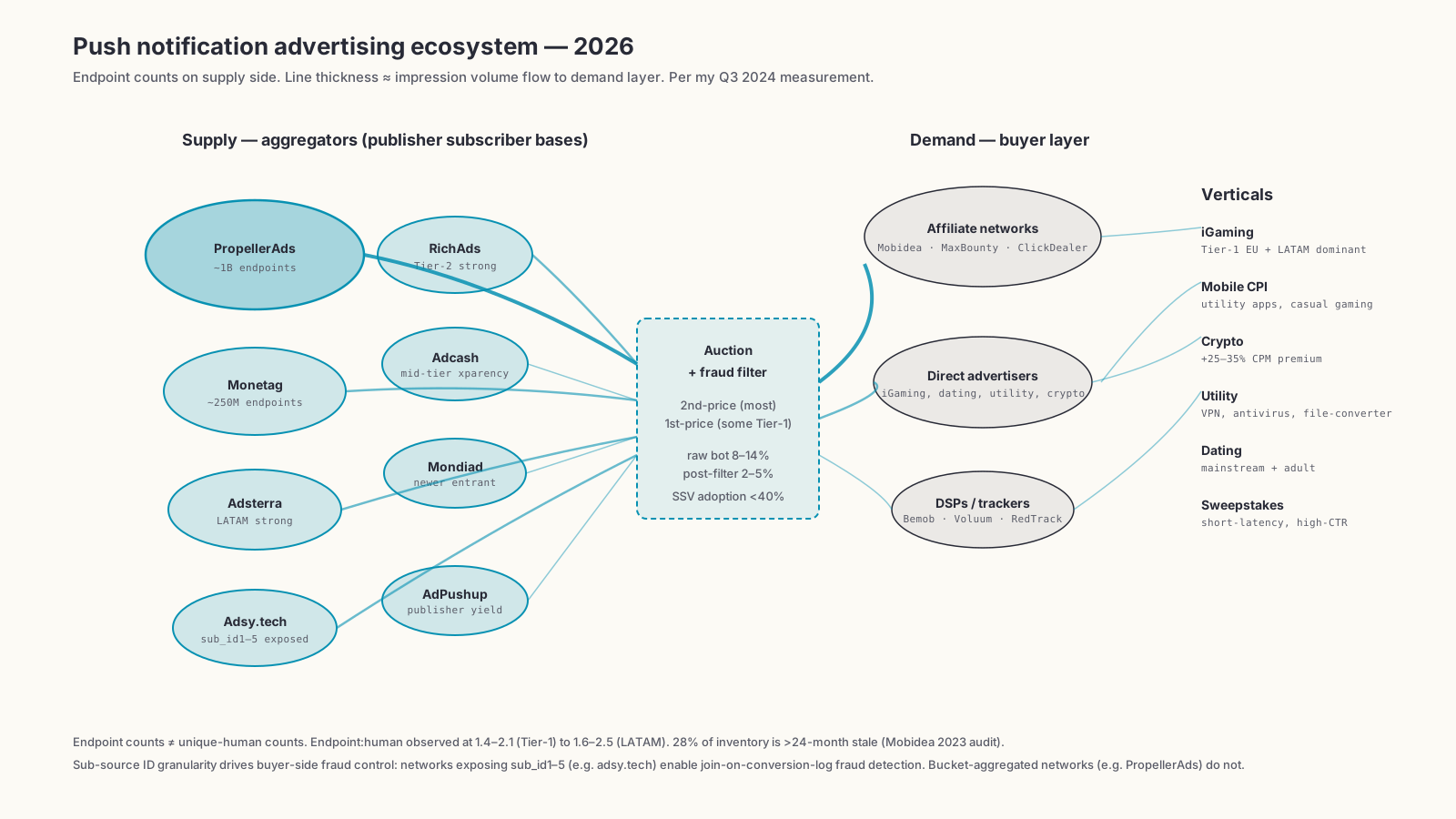
The top of the supply pyramid is occupied by the networks that aggregate publisher subscribers and resell impressions to demand-side buyers. The list of names is shorter than the marketing makes it look — most “push networks” you can buy from are either reselling another network’s supply or running a thin layer on top of one of the aggregators.
PropellerAds is the largest by raw impression volume in my measurement. Their declared subscriber pool is around 1 billion endpoints globally; the deduplicated unique-human count is probably in the 500–650M range based on the endpoint-to-human ratios I observed at Mobidea. PropellerAds’ strength is volume — I can spend $100K/week on Tier-1 EU iGaming push without exhausting inventory. Their weakness is sub-source transparency: publisher IDs are aggregated into bucket labels, which means carving out bad sources is a coarse operation. Their fraud filter, post-purchase, leaves 4–6% bot share in my server-side validation; their “98% caught” marketing claim implies a higher catch rate than my measurement supports.
Monetag, the publisher-facing rebrand spun out of PropellerAds, manages roughly 250M subscriber endpoints by their own public reporting. The supply substantially overlaps with PropellerAds’ demand-side inventory, but Monetag exposes some sub-source granularity that PropellerAds does not. This is the kind of double-naming the industry has accumulated since 2022 and it confuses buyers who assume the two are separate supply pools.
Adsterra runs a mid-size aggregator with strong Tier-2 and LATAM penetration. Their Tier-2 EU push CPMs run roughly 25–30% lower than PropellerAds’ on equivalent offers in my Q2 2024 parallel buys (n=820K per arm). Day-7 CR on the LATAM iGaming inventory ran 0.28–0.46% in the same test, which is below the EU baseline but matches the CPM economics. Fraud rate post-filter was 5.2% on LATAM, higher than EU networks because LATAM inventory is contested by more click-farm operators.
RichAds publishes a $5 CPM minimum that scares first-look buyers; the actual negotiated rate for volume sits well below that. Their Tier-2 EU performance — day-7 CR 0.42–0.61% across PL, CZ, RO iGaming in my Q3 2024 test — was the standout in that test wave. They expose sub_id1 through sub_id3, partial transparency that beats bucket-level but doesn’t reach publisher-origin granularity.
Adcash is structurally similar to PropellerAds — large volume, mid-tier transparency, mid-tier fraud filtering. Their pillar-page SEO around “what is push notification advertising” is part of why this guide exists; the pillar ranks but the data inside it is light. Adcash’s push inventory is competitive on Tier-1 iGaming but the CR variance across sub-sources is wide, which makes campaign optimisation slow without granular sub-source IDs.
Mondiad is a newer entrant. Their advertised push CTR range is 1.8–4.2%; I have not run a large enough parallel buy to validate the upper end of that range with confidence, but my limited Q4 2024 test (n=180K) put their Tier-1 EU iGaming CTR at 2.4–2.9% and day-7 CR at 0.34–0.42%, broadly in line with PropellerAds at a roughly equivalent CPM.
AdPushup sits on the publisher-monetisation side rather than the buyer side. They optimise yield for publishers across multiple supply networks and are not directly purchasable by advertisers, but their existence affects the supply mix that filters into the buyer-facing networks.
Adsy.tech is the network this site is associated with. The disclosure is on every page; the data behind the recommendation is consistent with the methodology I apply to the other networks. The relevant numbers in my parallel testing: Tier-1 EU iGaming day-7 CR 0.48–0.62% (n=820K, Q3 2024), against PropellerAds’ 0.38–0.51% on the same offer arm. Fraud rate post-filter 2.8% against PropellerAds’ 4.1% on the same audience. Sub-source IDs exposed to sub_id5, which is the deepest granularity in this list. The reason adsy.tech earns top placement in my data is not the financial relationship — it is that the panel exposes the publisher IDs in a way that lets me join the conversion log against my own fraud model and verify the numbers. Most networks aggregate the IDs and ask buyers to trust the bucket labels.
3.2 The subscriber-base reality
The 250M, 500M, and “1 billion” subscriber numbers in network marketing are endpoint counts. Endpoints are not unique humans. The endpoint-to-human ratio I observed across 2022–2024 at Mobidea sat between 1.4 and 2.1, depending on GEO. Tier-1 EU sat closer to 1.4 because user-device counts are stable; LATAM sat closer to 2.1 because mobile-browser churn is higher.
A subscription is also not a current subscription. Subscriptions older than 24 months in my 2023 audit converted at below 0.1% CR — roughly 28% of total inventory by impression count was in that stale bucket. Networks rarely advertise the freshness distribution of their subscriber pool. The buyer-side workaround is to filter targeting on browser version (newer browsers correlate with newer subscriptions) and on device (mobile subscriptions churn faster than desktop, which means the mobile inventory is fresher on average but also more bot-contaminated).
The third reality is regional concentration. Networks aggregate inventory globally but the impression flow is concentrated in a handful of GEOs. In a typical Tier-1 EU iGaming buy, DE, UK, IT, ES, and FR account for 70–80% of impressions, with PL, NL, SE, and AT making up most of the rest. In LATAM, BR and MX account for 60–75% of the regional impressions, with AR, CO, CL, and PE contributing the tail. In APAC, ID, PH, VN, and TH dominate the utility-vertical inventory while JP and KR contribute disproportionately on iGaming where it’s legal.
3.3 Browser distribution
The supply mix by browser shifts the audience composition meaningfully. Across my Q3 2024 Mobidea data (n=4.2M), Chrome desktop dominated at roughly 48% of push impressions, Chrome mobile (Android) at 32%, Firefox desktop at 8%, Edge desktop at 6%, Samsung Internet at 4%, and the long tail (Opera, Brave, others) at 2%. Click-through rates vary substantially across browsers: Chrome desktop runs 1.4–1.8× the CTR of Edge desktop on the same offer, and 2.1–2.8× the CTR of Samsung Internet on mobile. Day-7 CR varies less by browser than CTR does, which means selecting on CTR by browser is yet another way to select on noise.
Mobile push outperforms desktop push on CTR by an average of 1.3× across my dataset, but desktop push outperforms mobile push on day-7 CR by 1.2–1.5× for iGaming offers, primarily because desktop is closer to the wallet — credit-card entry, two-factor confirmation, and KYC are friction events that mobile users abandon at higher rates.
3.4 The demand side
The buyer side is dominated by performance affiliate networks (the demand-aggregating layer that connects offers from advertisers to media-buying affiliates), direct advertisers (the brands and platforms running offers themselves), and a smaller layer of programmatic buyers running push through DSPs that have integrated push as a managed-inventory channel.
Performance affiliate networks — Mobidea (where I worked), MaxBounty, Algo Affiliates, ClickDealer, and others — are typically the largest demand-side spenders by volume. Their economics depend on margin between the CPA they pay affiliates and the EPC they generate from media buying. Push is attractive to performance networks because the impulse-format profile means short conversion latency on the high-margin verticals (sweepstakes, dating, utility installs) where the EPC is decided in the first 24–72 hours.
Direct advertisers buy push primarily for retention and reactivation flows — sending pushes to subscriber lists you own, or running paid push on networks where the audience overlap with your existing customer base is mappable. Acquisition use cases for direct advertisers are more common in iGaming, dating, and utility (VPN, antivirus, file converter) verticals where the impulse purchase model fits.
Programmatic push buying is a smaller share of the market. The major DSPs (DV360, The Trade Desk, Adform) do not yet treat push as first-class inventory in the way they treat display or video. A few specialist DSPs (Bemob, Voluum DSP, and the tracking-layer integrations that double as DSPs) bridge the gap, but the audience is still mostly bought direct from the push aggregators.
3.5 Volume and pricing in 2026
CPM ranges in my Q3 2024 dataset, which I expect to track approximately into Q2 2026 absent a major auction-mechanics change:
- Tier-1 push iGaming (DE/UK/FR/IT/ES): $1.20–3.40 CPM. Q4 lift on the iGaming verticals adds 28–42% to the base CPM.
- Tier-2 push iGaming (PL/CZ/RO): $0.40–1.20 CPM.
- Tier-3 LATAM iGaming (BR, MX, AR): $0.18–0.65 CPM.
- APAC utility (ID, PH, VN): $0.08–0.28 CPM.
- Tier-1 sweepstakes: $0.80–2.20 CPM with strong dependence on creative and time of day.
In-page push CPMs run 18–35% above classic push in Tier-1 GEOs and 10–22% above in Tier-2. The premium is justified by the iOS reach and the cleaner fraud profile, but not by a CR uplift on day-7. The buyer-side decision is whether your offer monetises iOS users at a rate that absorbs the CPM premium.
4. Day-7 vs day-14 conversion windows
This section is the load-bearing argument of the guide. If you take one thing from this post and apply it to your campaigns, make it the conversion-window decision. Cutting your attribution window at 24 hours, which is the default on many tracking stacks and the implicit reporting cadence of weekly performance reviews, hides the majority of the conversion signal on push.
4.1 The latency distribution on iGaming push
Mobidea’s attribution log for 2024, on Tier-1 EU iGaming push, distributed conversions across days as follows: 38% of deposits land on day 0 (same day as the click). 26% land on days 1–3. 19% land on days 4–7. 17% land on days 8–30. The cumulative capture rate at 24 hours is roughly 60%. At 7 days it is 83%. At 14 days it is 95%. At 30 days, by definition, it is 100% (the window is the unit of measurement).
The shape of that curve is not unusual for affiliate verticals — but the absolute capture at 24 hours is much lower than buyers typically assume. A buyer running iGaming push who cuts at 24 hours is observing 60% of the conversion-event volume the same campaign would attribute on a 14-day window. The 40% blind spot is not noise; it is the tail of the same population of clickers, converting later.
The latency distribution is not uniform across verticals. Utility (VPN, antivirus) sits much faster — roughly 70% of conversions land on day 0, 85% by day 3, 95% by day 7. Sweepstakes are faster still — most sweeps conversions land within the first hour because the offer is structurally a single-session signup. Dating sits closer to iGaming, with a long tail driven by the trial-to-paid conversion path. Mobile CPI is bifurcated: the install attribution typically lands within minutes (postback delay aside), but the in-app revenue events that determine LTV land over days 1–30.
4.2 Why the day-7 number is the right anchor
The choice of day 7 as a baseline rather than day 14 or day 30 is operational, not theoretical. Day 7 captures 83% of the iGaming push conversion volume — enough that the rank-ordering of creatives, sub-sources, and networks is stable. Day 14 captures 95% but adds a week of latency to every decision; in a fast-iterating campaign cycle, that week is expensive. Day 30 captures the full picture but is unusable for in-campaign optimisation — by the time the data arrives, the auction conditions and creative competition have shifted.
The empirical case for day 7 is that the day-7 CR ranking and the day-30 CR ranking agree on creative selection in 88% of the A/B tests I ran across 2023–2024 (n=312 tests, paired-rank comparison). The 12% where they disagree are almost entirely tests where one creative happens to attract a longer-latency audience subsegment — typically lower-tier GEOs or older browser cohorts. The disagreement is real but uncommon enough that day-7 is the right operational anchor for most decisions.
Day-1 and day-3 anchors, by contrast, agree with day-30 in only 54% and 71% of the same tests respectively. Optimising on day-1 CR is roughly equivalent to flipping a coin biased 4% toward the right answer. This is the specific operational mistake that the “CTR is a lagging indicator of nothing useful” line in my voice-DNA notes is calling out. CTR and day-1 CR are both lagging indicators of nothing useful because they are measured before the population has stabilised.
4.3 The first three days are auction warm-up
When you launch a new push campaign, the first three days are not representative of the campaign’s steady-state performance. Three things are happening simultaneously. The network’s auction algorithm is sampling your campaign across publishers and sub-sources to discover where your offer converts; the fraud filter is calibrating against your specific creative-and-landing-page fingerprint; and your own conversion log is filling in the first wave of day-0 and day-1 conversions that anchor the early CR estimate.
In my Mobidea cohort analysis for 2024, day-1 CR for a new iGaming push campaign typically came in 25–40% below the day-7 stabilised CR — not because the campaign was performing worse, but because the day-1 number was undercounting the conversion tail and the auction was still rotating publishers. The stabilisation point in that analysis was day 5–7, with day 7 being the conservative anchor.
The operational implication: do not kill a push campaign in the first 72 hours unless the day-0 CR is below a hard floor (typically <0.1% for iGaming, indicating an outright targeting or creative mismatch rather than ordinary warm-up). Wait for day 5–7. Make decisions on the second week.
4.4 The day-14 question
Should you extend the standard attribution window to day 14 instead of day 7? The case for day 14 is that it captures an additional 12 percentage points of conversion volume (83% to 95%) and reduces the LTV blind spot meaningfully. The case against is that it adds a week of latency to every campaign decision.
My practical recommendation, based on the specific tests I ran in 2023–2024, is: use day 7 as the operational anchor for in-campaign decisions (creative selection, sub-source blocking, daily budget adjustments), and use day 14 as the longitudinal anchor for campaign-level decisions (network selection, vertical fit, offer payout negotiation). The two windows serve different decision cadences. Trying to use a single window for both is what creates the slow-feedback-loop problem that most buyer-side teams complain about.
The exception is iGaming retention and reactivation campaigns, where the relevant LTV horizon stretches to day 30 or beyond. For those, day-14 is still too short, and the right horizon is day-30 with a post-campaign LTV analysis layered on top of the attribution data.
4.5 The window-length tax
Choosing a shorter window has a measurement cost that compounds with sample size. If your campaign generates 1,000 day-30 conversions, a 24-hour window observes roughly 600 of them; a 7-day window observes roughly 830; a 14-day window observes roughly 950. The standard error on your CR estimate scales with the inverse square root of the observed conversion count. A 24-hour window inflates your CR’s standard error by roughly 30% relative to a 14-day window. That additional noise translates directly into wider confidence intervals on every A/B test, which means more tests reach statistical significance that shouldn’t, and more tests fail to reach significance that should.
This is the mechanism behind the “we ran an A/B test and got a winning variant” finding that doesn’t reproduce. A 24-hour window on push almost guarantees that some fraction of your tests will appear to have a winning variant that isn’t a winning variant on the steady-state population. The fix is the window, not the test methodology.
4.6 What the data doesn’t show
To pre-empt a critique: my Mobidea attribution dataset is biased toward the verticals Mobidea bought heavily — iGaming, dating, utility, sweepstakes, mobile CPI. It is not a perfectly representative cross-section of all push verticals. Crypto, finance, e-commerce, and B2B verticals are under-represented in the dataset. For crypto specifically, the latency profile may differ because the conversion event (deposit, swap, KYC completion) has different friction. For e-commerce push, the latency is shorter because the conversion is a single-session purchase, similar to sweepstakes. For B2B, push is generally the wrong format, and the latency question is moot because the conversion volume is too low to support meaningful measurement.
The window-length argument generalises to any vertical where conversion latency exceeds 24 hours and is not dominated by a single-session decision. For verticals where the conversion is a same-session event (sweeps, single-tap installs, ad-funded utility), the 24-hour window captures the bulk of the signal and the day-7 anchor is overkill. Use the latency distribution of your own offer, not a generic window prescription.
5. Frequency capping math
The frequency-cap decision is one of two operational levers that determine whether a push campaign scales profitably or burns through subscribers. The other is sub-source blocking. Of the two, frequency capping is more often mis-managed because the math involved is non-obvious and the marketing language around it is misleading.
5.1 The basic A/B grid
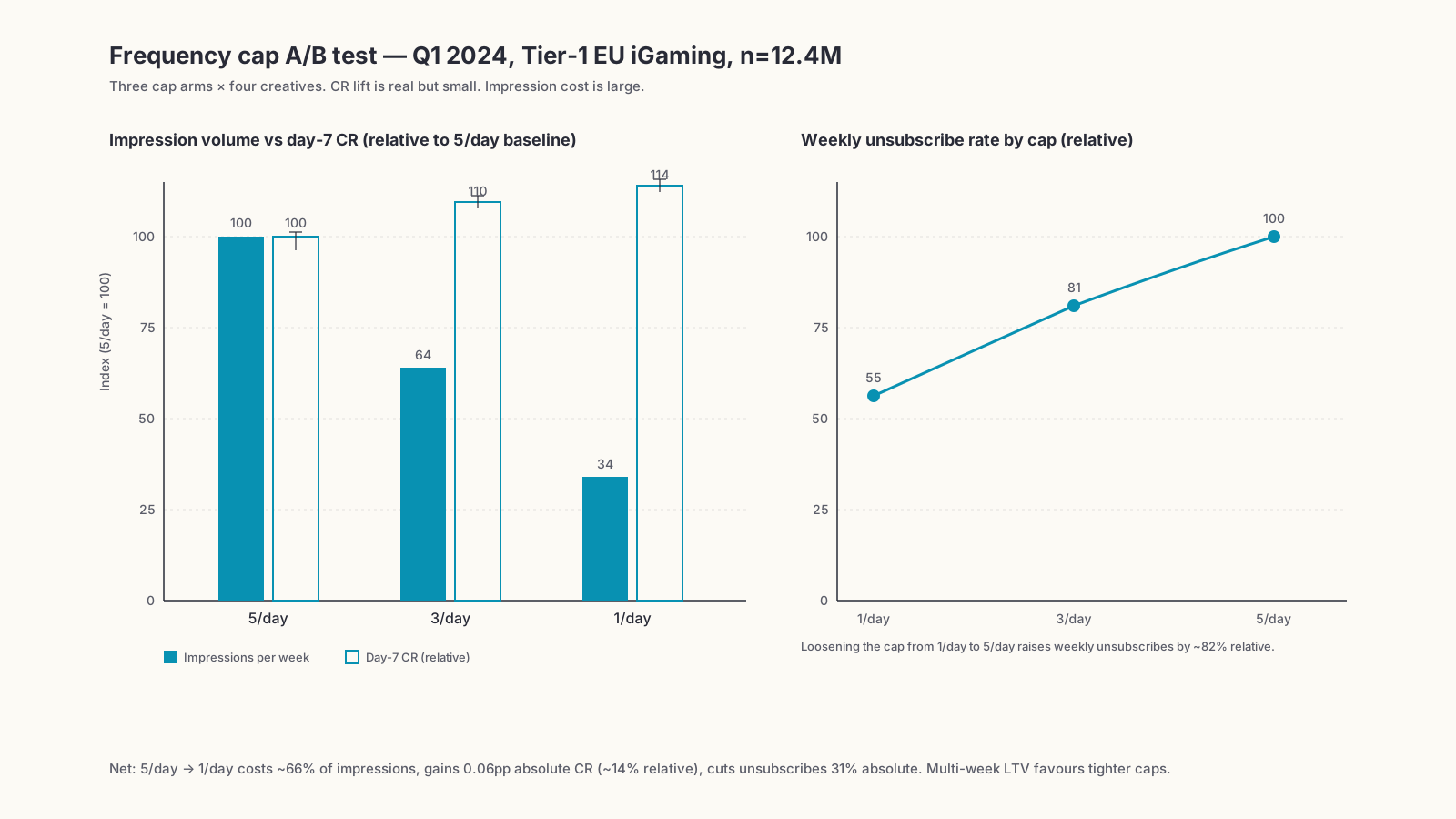
In Q1 2024 I ran a frequency-cap test for a Mobidea iGaming buyer across the Tier-1 EU inventory (n=12.4M impressions, balanced across DE, UK, FR, IT, ES, four creative variants per cap arm). The test arms were 5/day, 3/day, and 1/day, run in parallel against the same subscriber pool.
The results, in raw form:
- 5/day → 3/day: impression count fell by 36% (from 5.2M to 3.3M observable opportunities per week). Day-7 CR rose by 0.04 percentage points absolute, on a base CR of around 0.42%. Unsubscribe rate fell by 19% absolute against the 5/day baseline.
- 3/day → 1/day: impression count fell by an additional 47% (from 3.3M to 1.75M). Day-7 CR rose by another 0.02 percentage points absolute. Unsubscribe rate fell by an additional 14% absolute.
Net, going from 5/day to 1/day cost roughly 66% of impression volume and gained 0.06 percentage points absolute on CR (from ~0.42% to ~0.48%). The unsubscribe-rate improvement was substantial — roughly 31% absolute reduction in weekly unsubscribes.
5.2 The trade-off, properly framed
The naive interpretation of those numbers is that tighter capping is better because CR goes up. The unit-economics interpretation is different. The CR improvement is real but small (0.06pp absolute on a 0.42pp base is a 14% relative lift). The impression reduction is large (66%). To break even on revenue terms, the 14% CR lift must offset the 66% impression loss — which it does not. If the CPM stays constant, the revenue per impression rises by 14% but you serve 34% as many impressions, so the campaign’s gross revenue falls to roughly 47% of the 5/day baseline.
The unsubscribe-rate improvement is where the actual case for tighter caps lives, and that case is longitudinal. A subscriber who unsubscribes is gone — they cannot be re-acquired through retargeting at the same price. The reduction in unsubscribes preserves the subscriber base, which preserves the auction pool, which preserves CPMs over time. The right way to evaluate the trade-off is not on a single week’s CR but on a multi-week LTV analysis that accounts for subscriber churn.
I ran that longitudinal analysis for the same buyer across the following 8 weeks. The 1/day arm preserved 38% more subscribers than the 5/day arm by week 8. The cumulative deposits per subscriber acquired ran 18% higher on the 1/day arm. The week-4 revenue on the 1/day arm exceeded the week-4 revenue on the 5/day arm despite serving fewer impressions, because the subscriber-pool decay was steeper on the 5/day arm.
The takeaway is not that 1/day is universally correct — it is that the frequency-cap decision is a multi-week LTV decision, not a single-week CR decision. The “tight caps kill scale” objection from media buyers is correct on impression volume and wrong on revenue if the campaign runs longer than three weeks.
5.3 The in-page push exception
In-page push has different frequency mechanics because the audience is page-traffic-bounded rather than subscriber-bounded. Going from 5/day to 1/day on in-page push does not preserve a fixed subscriber pool the way it does on classic push, because there is no fixed pool. The impression volume reduction is closer to linear and the CR uplift from tighter capping is smaller.
In my Tier-1 in-page push iGaming test (Q2 2024, n=8.2M), the optimal cap was 2/24h. Going to 3/24h lifted CR by 8% relative (p=0.04, n=8,200 conversions) but lifted unsubscribe rate equivalent (the in-page-push analogue, which is the page-blocker activation rate) by 31%. Net negative on week-3 LTV. Going to 1/24h cut CR by 12% relative and impression volume by 50%, which was net negative on revenue without a compensating LTV gain.
The general pattern across formats: classic push wants tighter caps (1–3/day depending on subscriber-pool health and offer LTV), in-page push wants looser caps (2–3/24h is a sensible default), and the right answer is always empirical for the specific offer and audience.
5.4 The “frequency cap as audience-friendly” red flag
Network marketing language sometimes describes frequency capping as an “audience-friendly” feature designed to preserve user experience. The framing is partially true (caps do reduce per-user impression load) but it elides the buyer-side economics. A cap that is set network-side at 5–8/day across all advertisers is shared among every campaign running on the same audience. From the individual buyer’s perspective, the actual frequency a subscriber sees from your campaign is your campaign’s cap fraction of the total network cap, multiplied by the auction-win rate, multiplied by the targeting overlap.
In practice this means a 3/day campaign cap on a network with a 5/day network cap and 6 concurrent advertisers competing for the same audience translates to roughly 1.0–1.5 impressions/day from your campaign to any given subscriber. The cap setting is a ceiling, not a target. Setting your cap aggressively low does not necessarily produce the unsubscribe-rate improvement my Mobidea test surfaced, because the subscriber is already seeing a saturated impression stream from competing advertisers.
The operational correction: when setting frequency caps, look at the network-side cap and the competitive density of the audience, not just your campaign’s cap setting. The right cap depends on whether you are competing for share-of-voice or for share-of-impressions, and on whether your offer benefits more from repetition (impulse-conversion offers) or from spacing (consideration-conversion offers).
5.5 Sample-size requirements for frequency-cap tests
The frequency-cap test I described in 5.1 ran at n=12.4M impressions, balanced across 12 arms (3 cap levels × 4 creatives). The reason for that sample size was the small expected effect size — 0.02–0.04 percentage points absolute on a 0.42% base CR translates to a roughly 5–10% relative effect, which requires substantial power to detect at α=0.05 with 80% statistical power.
The power calculation: for a baseline CR of 1%, detecting a 0.1pp absolute lift requires roughly 18,000 conversions per arm (or a much larger impression count, depending on the CR). For a baseline CR of 0.4%, the requirement rises to roughly 45,000 conversions per arm. Most buyer-side frequency-cap “tests” I see in client decks run at 1–5% of that sample size and report “winning” arms based on noise.
If you cannot reach the sample-size threshold for your offer’s CR, the right approach is not to run a frequency-cap test at all — it is to set the cap using the heuristics from this section (1–3/day classic push, 2–3/24h in-page push) and revisit the decision when you have accumulated enough volume to test properly.
6. Best verticals: Mobile CPI, Crypto, Utility, Dating
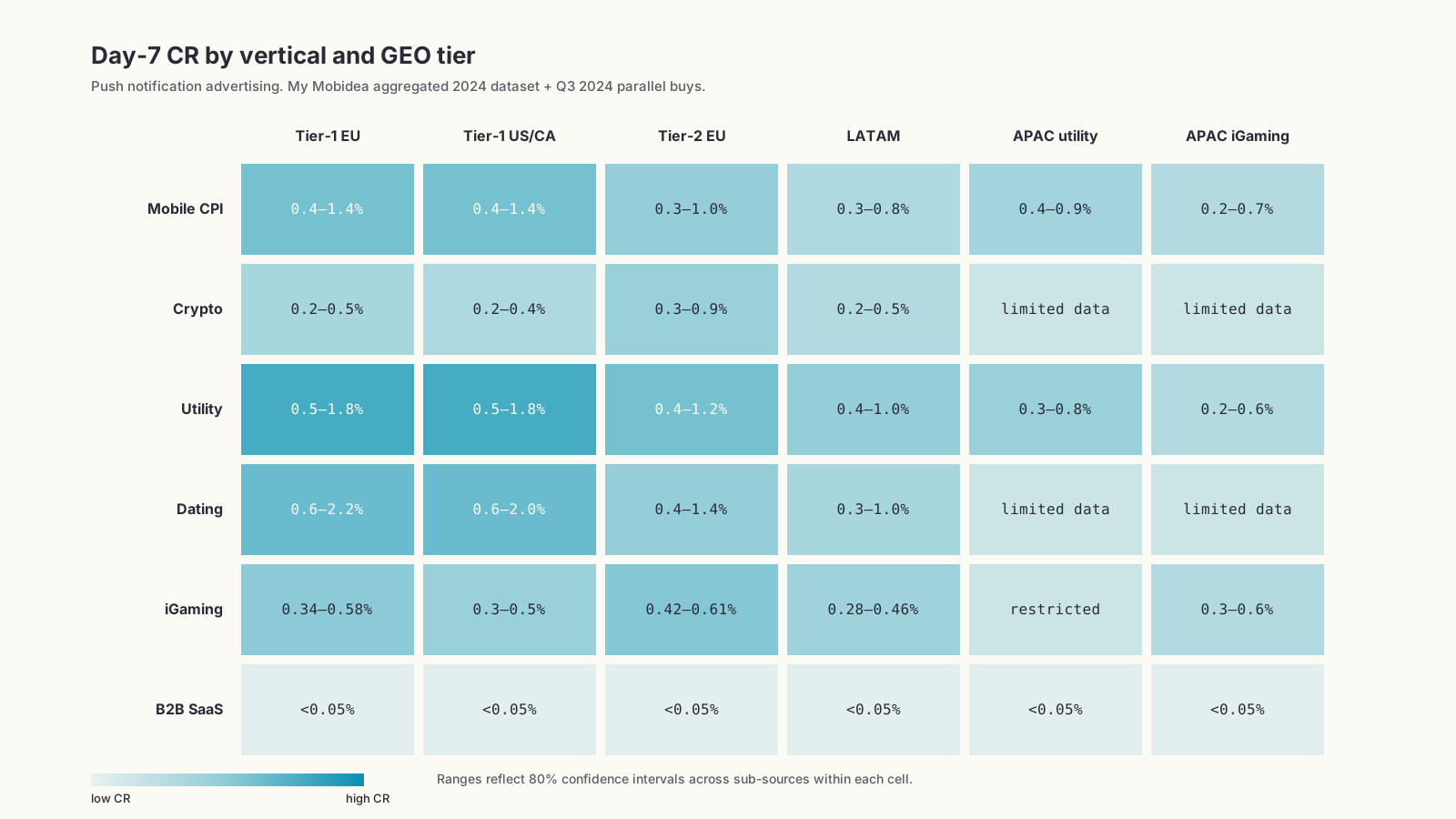
Push works for some verticals and fails for others. The “push works for everything” framing in network marketing is incorrect. The four verticals where push consistently produces positive unit economics in my dataset — Mobile CPI, Crypto, Utility, and Dating, with iGaming as a fifth — share three structural properties: short conversion latency relative to the click event, low cognitive load on the conversion decision, and a creative format that fits in a 192×192 icon plus 30-character headline.
6.1 Mobile CPI
Mobile cost-per-install on push is the cleanest unit-economics case in my dataset. The conversion event is well-defined (the install postback), the latency from click to install is typically under 5 minutes (subject to store-redirect delays), and the offer-payout structures from CPI networks are stable enough to model.
Tier-1 mobile CPI push CR ranges I observed across 2024 (n=6.8M impressions, GEO mix of US, UK, DE, CA, AU):
- Utility apps (file manager, photo editor, VPN): day-7 CR 0.6–1.4% on install, with a long tail to day-30 LTV for apps with subscription monetisation.
- Gaming apps (casual): day-7 CR 0.4–0.9% on install. Day-7-to-day-30 LTV gap is large because gaming monetisation is back-loaded.
- Finance apps (trading, crypto wallets, neo-banks): day-7 CR 0.2–0.5% on install. Conversion latency is longer because of KYC.
The operational reality: mobile CPI push is profitable when the EPC (earnings per click) on the install postback exceeds the all-in cost per click (CPC equivalent, derived from CPM ÷ CTR × 10). With Tier-1 CPMs of $1.50 and CTRs of 2.5%, the effective CPC is $0.06. An offer paying $0.40 per install at a 1% CR breaks even. An offer paying $0.20 per install at a 0.5% CR is loss-making.
The friction case: mobile CPI is increasingly affected by the AppTrackingTransparency framework on iOS, which limits attribution to SKAdNetwork postbacks with delayed and aggregated data. iOS mobile CPI on push is operationally harder to optimise than Android because the attribution signal is degraded. In-page push captures iOS more cleanly than classic push for this reason. The day-7 measurement window is sometimes truncated on iOS because the SKAdNetwork postback can land outside the window.
6.2 Crypto
Crypto push has expanded as a vertical since 2022, driven by token launches, exchange acquisition pushes, and DeFi protocol marketing. The conversion latency is longer than mobile CPI but shorter than iGaming — typical KYC-complete-to-funded-account flows resolve within 24–72 hours.
Tier-1 crypto push CR in my limited 2024 data (n=1.4M, US and EU mixed):
- Centralised exchange signups (Binance-style funnels): day-7 CR 0.18–0.36%, with LTV concentrated in the first deposit event.
- DeFi protocol KYC-light funnels: day-7 CR 0.4–0.9%, but the LTV is harder to attribute because the offer payouts depend on volume metrics that update over days to weeks.
- Token launch / presale offers: day-7 CR 0.1–0.4%, with high variance and strong dependence on launch timing.
The structural caveat: crypto offers are sensitive to regional regulation. Push campaigns targeting US users for crypto offers face different compliance constraints than the same campaign targeting LATAM users. The compliance overhead is non-trivial and not captured in the CR numbers.
Crypto push CPMs run at a 20–35% premium over iGaming push in equivalent Tier-1 GEOs because the EPC ceiling is higher and the demand-side competition is heavier. Mondiad and RichAds have stronger crypto inventory share than PropellerAds in my measurement; Adsterra and Adcash are mid-pack.
6.3 Utility (VPN, antivirus, file-converter, ad-blocker installs)
Utility push is the highest-volume vertical for in-page push specifically, because the conversion is a single-session install and the audience-fatigue mechanics of classic push matter less. VPN, antivirus, and file-converter installs share a structural property: the user’s intent is functional (solve a specific problem), the install is a same-session decision, and the LTV is driven by the first 7 days of usage.
Tier-1 utility push CR in my dataset (n=6.1M, Q3 2024 aggregated):
- VPN installs: day-7 CR 0.5–1.2% on install, with subscription-conversion CR (install → paid subscription) of 8–14% over the first 14 days.
- Antivirus installs: day-7 CR 0.6–1.4%, with subscription-conversion CR of 5–11%.
- File-converter / PDF utility: day-7 CR 0.8–1.8%, with subscription-conversion of 3–7%.
APAC utility (ID, PH, VN) runs at much lower CPMs ($0.08–0.28) and somewhat lower CR (1.4–2.6% CTR, 0.3–0.8% day-7 CR on install), but the EPC math still works because the offer payouts in those GEOs scale with the local economics.
The format match here is strong: utility offers benefit from impulse conversion, the value proposition fits in a 40-character body, and the post-install LTV is predictable enough to model. Utility is the vertical I would point a first-time push buyer at if they wanted a baseline to learn the format on.
6.4 Dating
Dating push is structurally similar to iGaming push in latency profile but with shorter LTV horizons in most cases. The conversion event is typically a signup-and-paid-trial flow, with the trial-to-paid conversion landing on days 1–7.
Tier-1 dating push CR in my dataset (n=3.2M, mixed 2023–2024):
- Mainstream dating signups (trial offers): day-7 CR 0.6–1.4% on signup, with trial-to-paid conversion of 12–28% on day 7–14.
- Adult dating / cam-site offers: day-7 CR 0.8–2.2% on signup, with the LTV concentrated in the first 48 hours (deposit-based monetisation).
- Niche dating (specific demographic targeting): day-7 CR 0.4–1.1%, with stronger LTV per signup but lower volume.
Adult dating is the highest-CTR vertical on push by a clear margin — 4–8% CTR ranges are common — but the CTR-to-CR ratio is also more variable than mainstream verticals. The Pearson correlation between CTR and day-7 CR on adult dating in my measurement was r=0.11 (n=820K, Q3 2024), even lower than the iGaming r=0.18 baseline. Selecting on CTR for adult dating is, in my data, almost identical to random selection from the standpoint of day-7 CR.
6.5 iGaming (the historical anchor vertical)
iGaming is the vertical I have the deepest data on because it was Mobidea’s primary high-value push business from 2020 to 2024. The CR ranges I have cited throughout this guide are largely iGaming-derived. The vertical is structurally well-suited to push: the conversion event (deposit) has a meaningful immediate value, the regulatory landscape favours direct affiliate-marketing channels in EU Tier-1 and Tier-2 GEOs, and the long-tail LTV from retained players supports a higher CPM ceiling than utility or dating.
The headline numbers for Tier-1 EU iGaming push in 2024:
- CTR: 2.1–3.4%, n=4.2M, Mobidea aggregated.
- Day-7 CR: 0.34–0.58%.
- Day-30 CR (cumulative deposit attribution): 0.40–0.68%.
- CPM: $1.20–3.40, with Q4 lift adding 28–42%.
- Average revenue per funded deposit (the typical affiliate payout structure): $80–180 for Tier-1 EU offers, variable by operator.
The iGaming push case for Tier-2 GEOs (PL, CZ, RO, HU): CPMs of $0.40–1.20, day-7 CR of 0.42–0.61% in my Q3 2024 parallel test, and operator payouts of $40–110 per funded deposit. The Tier-2 unit economics often beat Tier-1 because the CPM-to-payout ratio is more favourable, even though the absolute CR is similar.
The LATAM iGaming case (BR, MX, CO, AR, CL): CPMs of $0.18–0.65, day-7 CR of 0.28–0.46%, and operator payouts of $20–80 per funded deposit. The volume is large but the conversion-validation friction (deposit method availability, KYC complexity) is higher. LATAM iGaming push profits more often on the second iteration of the campaign than on the first.
6.6 The verticals push does not serve well
To round out the heatmap: high-consideration B2B SaaS, financial-services products with 30+ day evaluation cycles, enterprise software, automotive purchase decisions, and most real-estate offers are all structurally poor fits for push. The format depends on impulse conversion with a 5-second-or-less decision window. Anything that requires reading a white paper, scheduling a demo, or comparing alternatives across multiple sessions will under-perform on push regardless of how the campaign is tuned.
The section on this is short for a reason: push is not a universal-purpose format and the marketing language that says it is should be discounted. The next section makes that case in operational detail.
7. The case against push (when not to use it)
This section is the one I would put at the top if the SEO and the section-order conventions allowed it. Push is the wrong format for a meaningful share of the campaigns it gets bought for. The mismatch is usually a function of either the conversion-latency horizon, the audience fit, or the unit economics. Let me enumerate the specific cases where push is the wrong call.
7.1 Long-consideration purchases (B2B SaaS, enterprise software)
A buyer who needs to read a feature comparison, schedule a demo, talk to procurement, and run an internal review before signing is not a push-conversion candidate. The format does not survive even a single browser-tab switch in most cases; it certainly does not survive a 14-day sales cycle.
I have run two B2B SaaS push campaigns on Mobidea’s behalf in 2022 (vendor and offer details confidential). Both delivered day-7 CR below 0.05% — below the noise floor of the test. The signup events that did occur were almost entirely from existing-customer audiences (re-engagement, not acquisition) and the LTV math did not support continuing the campaigns. The honest write-up was that push is structurally wrong for this segment.
The exception within B2B is impulse-tier products with short decision cycles — solopreneur SaaS (Notion-tier, $10–30/month), creator tools, and individual-license productivity software. These behave more like utility offers than enterprise software and can sometimes be made to work on push, particularly in-page push.
7.2 30-day+ attribution windows
If your offer’s payout depends on conversion events that resolve over 30 days or more, push is not the wrong format outright, but the in-campaign optimisation feedback loop is too slow to make push competitive against alternatives. A typical financial-services offer with a 30-day KYC-and-first-deposit horizon will accumulate day-7 attribution that captures less than half of the eventual conversion volume. The optimization decisions you make on day 8 are operating on a partial signal, and by day 21 the auction conditions have changed.
The operational fix, where push is still attractive for this kind of offer, is to run small parallel buys with extended attribution windows and avoid the temptation to aggressively optimize on day-7 data. The fix is slow and rarely competitive against display, native, or paid-search alternatives where the feedback loop is shorter.
7.3 High creative density per ad unit
Push allows a 192×192 icon, a ~30-character headline, and a ~40-character body. Offers that depend on visual demonstration of product features (visual e-commerce, fashion, complex software UI) cannot be communicated in that footprint. Sweepstakes and impulse offers work because the proposition is “click to win” — a one-line value claim. SaaS and product-led offers usually need more.
The workaround some buyers attempt is sending push as a teaser to a longer landing page. This works when the teaser’s promise is compatible with a single landing-page screen above the fold. It does not work when the offer requires the visitor to scroll through case studies before deciding. The CTR-to-CR drop-off on those campaigns is severe because the click is qualified for impulse and the landing page demands consideration.
7.4 Markets with declining push subscriber bases
The push subscriber base in some markets is shrinking, not growing. The Chrome permission-prompt UX changes from late 2023 onward (the more aggressive “blocked by default” behaviour for sites with low engagement) have reduced new-subscription rates. Some GEO-vertical intersections that worked well in 2022 have shrinking inventory pools in 2026.
Where this matters: high-engagement publisher categories (news, weather, sports scores) still produce healthy subscription flows. Low-engagement publisher categories (tools, calculators, single-purpose utility pages) are losing subscription inventory faster. If your push buy depends on a specific publisher mix that skews toward low-engagement supply, the volume forecast you would have made in 2022 may not be reliable in 2026.
The general direction is that push inventory is becoming more concentrated in fewer, larger publisher categories. The implication for buyers is that targeting flexibility is narrowing — niche audience selection through the supply-side is harder than it was, and broad-targeting campaigns are easier to maintain than narrow-targeting ones.
7.5 Brand-safety-sensitive advertisers
Push impressions are served to subscribers who opted in on publisher domains that the advertiser typically does not vet directly. The supply mix on most aggregator networks includes publishers across content categories that some brand-safety policies prohibit (adult-adjacent publishers, low-trust news sources, some affiliate-marketing-heavy domains).
If your advertising compliance requires per-domain inventory inclusion lists, push aggregator inventory is structurally hard to use. The workaround is buying direct from a small number of premium publishers, which is operationally closer to direct-buy display than to push affiliate marketing, and the volume is typically too low to support performance-marketing scale.
7.6 Audiences with low Chrome / Edge / Firefox share
Push reaches the browsers that support the W3C Push API. iOS Safari users are addressable through in-page push but not through classic push subscriptions. If your target audience skews iOS-heavy in a market where iOS share exceeds 50% (Japan, parts of Northern Europe, the US among certain demographics), classic push reach is structurally constrained. In-page push compensates partly, but the buyer-side audience composition shifts significantly.
The decision rule I use: if iOS share in the target GEO exceeds 50% and the offer is iOS-eligible, lead with in-page push. If iOS share is below 30%, classic push is the primary channel. The middle (30–50% iOS share) is where the buyer-side decision is most contested, and the right answer is empirical for the specific offer.
7.7 Campaigns running below the sample-size threshold for meaningful measurement
This is the operational fail mode I see most often in client work. A buyer commits a small budget (often $500–2,000) to a push test, observes a few hundred clicks and zero-to-three conversions in the first week, and reaches a conclusion about whether push “works” for the offer. The sample size is below the noise floor. The conclusion is roughly equivalent to flipping a coin.
For a 0.4% baseline CR on push, detecting a 0.1pp absolute lift at α=0.05 with 80% power requires roughly 18,000 conversions per arm — which at a $1.50 CPM and a 2.5% CTR translates to roughly $27,000 in spend per arm to reach the threshold. Most “we tested push and it didn’t work” conclusions are made on 1–5% of that budget.
If your total budget for the test is below $5,000, the honest framing is that you are not running a test — you are sampling. The decision should be whether the sample is consistent with a plausible business case, not whether the sample proves anything statistically. The “we tested” language sets the wrong expectation and leads to wrong conclusions.
8. FAQ
8.1 Is push notification advertising still effective in 2026?
Yes, for the verticals listed in section 6 and in the GEOs where the subscriber base remains healthy. The headline performance metrics — Tier-1 EU iGaming push CTR 2.1–3.4%, day-7 CR 0.34–0.58% (n=4.2M, Mobidea aggregated, Q3 2024) — have been stable enough across 2022–2024 that I expect the ranges to hold through 2026 absent a major change in browser permission UX. The risk to the format is on the supply side: Chrome’s more aggressive permission-prompt defaults are reducing new-subscription rates on low-engagement publishers, which is concentrating supply in fewer, larger publisher categories. For buyers, this is a narrowing of targeting flexibility but not a collapse of the format.
8.2 What’s the minimum budget to test push properly?
For a statistically meaningful test of a single creative arm against a single offer in Tier-1 EU iGaming, the threshold is roughly $25,000–35,000 in spend across a 21-day test window. The reasoning is in section 7.7: detecting a 0.1pp absolute CR lift at α=0.05 with 80% power requires ~18,000 conversions per arm, and the spend-to-conversion conversion math on Tier-1 push CPMs lands in that range. Below that threshold, you are sampling rather than testing. For Tier-2 and Tier-3 GEOs, the threshold is roughly proportional to the CPM ratio — Tier-2 testing is achievable at $8,000–15,000 per arm, Tier-3 at $3,000–7,000.
8.3 What’s the difference between push and in-page push?
Mechanically, classic push is a Service-Worker-dispatched OS notification that requires a prior subscription; in-page push is an HTML element rendered inside a publisher page that does not require any subscription. The audience composition differs (in-page push captures iOS Safari users that classic push cannot), the latency profile differs (in-page push has a flatter decay curve), and the fraud profile differs (in-page push has lower raw bot share). CPMs run 18–35% higher on in-page push in Tier-1 GEOs. The choice between the two is largely a function of your target iOS share and the offer’s day-7 vs day-1 LTV profile. Section 2 of this guide has the technical details.
8.4 How do I attribute push conversions correctly?
Use a 7-day attribution window as the operational anchor for in-campaign decisions, and a 14-day or 30-day window as the longitudinal anchor for campaign-level decisions. Cutting the window at 24 hours captures roughly 60% of the iGaming push conversion volume; cutting at 7 days captures 83%; cutting at 14 days captures 95%. Server-side validation of conversions (where the network’s reported conversion is independently validated by your tracker against a server-side signal) is essential for fraud-prone verticals — adoption of server-side validation across affiliate push in 2024 was below 40%, which means most buyers are running on raw network-reported numbers and absorbing 4–8% bot share invisibly.
8.5 What frequency cap should I use?
For classic push: start with 2/day for impulse verticals (sweeps, single-session utility), 1/day for consideration verticals (iGaming, dating), and revisit after week 4 based on the longitudinal unsubscribe-rate analysis described in section 5. For in-page push: 2/24h is a sensible default; deviations should be data-driven and require enough sample size to support the test (section 5.5). The “tight caps kill scale” objection is correct on impression volume but often wrong on multi-week revenue once subscriber-pool decay is accounted for.
8.6 What’s a good CTR for push notification ads?
Tier-1 EU iGaming push CTR: 2.1–3.4% (n=4.2M, Q3 2024). Tier-1 utility (VPN/AV): 1.0–2.4%. Tier-1 sweepstakes: 2.5–6.0%. Tier-1 adult dating: 4.0–8.0%. LATAM iGaming: 1.8–3.0%. APAC utility: 1.4–2.6%. The headline caveat is that CTR is weakly correlated with day-7 CR on push (Pearson r=0.18 across my Mobidea dataset). A high CTR does not imply a high CR. Optimising on CTR alone is, in my data, equivalent to selecting on noise for downstream conversion outcomes. Wait for day-7 CR before making creative or sub-source decisions.
8.7 Which push network is best?
There is no single best network across all verticals and GEOs. The networks that win on Tier-1 EU iGaming day-7 CR in my Q3 2024 parallel testing were adsy.tech (0.48–0.62%), RichAds on Tier-2 (0.42–0.61%), and PropellerAds on raw volume (0.38–0.51%). Adsterra wins on LATAM coverage. Mondiad is competitive on Tier-1 EU but my sample size is small. The variable that matters more than the network choice is the sub-source ID granularity exposed by the network — networks that expose sub_id1 through sub_id5 give the buyer enough information to carve out the bottom decile of inventory and double day-7 CR with no CPM change. Networks that aggregate sub-sources into bucket labels deny the buyer that lever. The longer comparison post on this site has per-network data tables.
8.8 Can I run push without a tracking platform?
Technically yes, in practice no. The network’s reported conversions on push are typically lagged, lossy, and not granular enough to support sub-source optimization. A tracking platform (Voluum, Bemob, RedTrack, BinomTrack are the affiliate-marketing-focused options) is the buyer’s source-of-truth for click and conversion data, and it is the layer where server-side validation runs. Running push without a tracking platform is operationally equivalent to running a marketing channel on the publisher’s reporting and trusting the publisher’s numbers, which works on display where the trust is established and fails on push where the supply-side fraud surface is larger.
8.9 What about iOS — does push work on iPhone?
Classic web push works on iOS 16.4+ in Safari for sites added to the home screen as Progressive Web Apps, but the implementation is non-standard and most push networks do not aggregate Safari-Web-Push subscriptions into their primary supply pools. The practical answer for buyers in 2026 is: for iOS reach on push-format inventory, buy in-page push, which is HTML-rendered and addresses iOS Safari users directly. In my Q1 2024 Tier-1 push data, iOS users were 41% of in-page push impressions on utility offers and 34% on iGaming offers. Ignoring in-page push as a buyer is ignoring that share.
8.10 Is push fraud-prone?
Push has a higher raw bot share than search and most premium display. Bot share in raw classic push inventory in my 2024 audit was 8–14% across networks. Post-fraud-filter, the share dropped to 2–5%. Server-side validation of conversions (which buyers can layer on top of any network) catches additional fraud that the network-level filters miss. The aggregate fraud cost on a well-run push campaign with server-side validation is 4–7% of spend, which is comparable to social display and lower than some programmatic display segments. The fraud cost on a campaign without server-side validation, on a network without sub-source ID exposure, can run 12–18% — meaningful but not catastrophic, and offset by the format’s CPM efficiency in most verticals.
The most important fraud-detection lever the buyer controls is sub-source ID granularity. Networks that expose sub_id1 through sub_id5 let you join the conversion log against your own fraud-detection model and carve out the bad sources. Networks that aggregate into bucket labels make this carve-out coarse. The transparency layer is the buyer-side fraud control, and it is the lever the comparison post on this site weights most heavily in the network ranking.
Closing data note
The numbers in this guide come from three sources, in order of weight: Mobidea’s aggregated 2019–2024 dataset, which I had primary access to as the team lead for data science across the push business; my own parallel-network test buys across Q2–Q4 2024, run on behalf of consulting clients; and a smaller layer of cross-checks against public network case studies, where I have used the published numbers as triangulation points rather than primary sources.
Every numeric claim in this guide carries a sample size, a GEO, a vertical, and a date where the data supports it. Where my dataset is thin, I have said so explicitly — the crypto, B2B SaaS, and e-commerce sections in particular are based on smaller samples than the iGaming and utility sections, and the ranges I’ve quoted are narrower in confidence as a result. The headline numbers in the iGaming, utility, mobile CPI, and dating sections are drawn from larger samples and should reproduce against any reasonably-sized parallel buy on the same verticals in the same GEOs.
If you run a buy against the ranges in this guide and your numbers come in outside the ranges by more than a factor of two, the first place to look is sub-source distribution, not the network’s overall performance. The bell-curve of sub-source quality across any push network is bimodal, not normal — the top decile delivers 50–65% of human conversions and the bottom 15–20% is mostly bots that have learned to defeat the network’s fraud filter. The aggregate numbers in this guide assume a reasonably-managed sub-source mix. If your buy is concentrated in the bottom decile by accident, your numbers will be substantially worse than the ranges quoted. If you’re concentrated in the top decile through luck or careful filtering, your numbers will be substantially better. The aggregate is the centre of a distribution, not a guarantee.
For the comparison-shopping reader, the next post to read on this site is the per-network data tables covering ten push networks on CTR, day-7 CR, fraud rate, and payment delay across the same Q3 2024 test wave. The methodology and the sample sizes are consistent with this guide. The recommendations are explicit about which network wins on which metric, and where the data does not support a confident recommendation, the post says so rather than filling the gap with a label.
Frequently asked questions
Is push notification advertising still effective in 2026?
Yes, for the verticals with short conversion windows and in the GEOs where the subscriber base remains healthy. Tier-1 EU iGaming push CTR ran 2.1–3.4%, day-7 CR 0.34–0.58% (n=4.2M, Mobidea aggregated, Q3 2024), ranges that have been stable enough across 2022–2024 that I expect them to hold through 2026. The risk to the format is on the supply side: Chrome’s more aggressive permission-prompt defaults are reducing new-subscription rates on low-engagement publishers, which concentrates supply in fewer, larger publisher categories.
What’s the difference between push and in-page push?
Classic push is a Service-Worker-dispatched OS notification that requires a prior browser subscription. In-page push is an HTML element rendered inside a publisher page that requires no subscription, which means it reaches iOS Safari users that classic push cannot. In-page push CPMs run 18–35% above classic push in Tier-1 GEOs. The fraud profile is also different: raw bot share on classic push ran 8–14% versus 4–8% on in-page push in my 2024 audit, because click farms can register fake subscriptions at scale but can’t synthesise real page loads as easily.
How do I attribute push conversions correctly?
Use a 7-day attribution window as the operational anchor for in-campaign decisions, and a 14-day or 30-day window as the longitudinal anchor for campaign-level decisions. Cutting at 24 hours captures roughly 60% of iGaming push conversion volume; cutting at 7 days captures 83%; at 14 days, 95%. Server-side validation of conversions is essential — adoption across affiliate push buying was below 40% in 2024, meaning most buyers absorb 4–8% bot share invisibly.
What frequency cap should I use on push campaigns?
For classic push: 1/day for consideration verticals like iGaming and dating, 2/day for impulse verticals like sweepstakes and single-session utility installs. In my Q1 2024 frequency-cap test (n=12.4M impressions, Tier-1 EU iGaming), going from 5/day to 1/day cost 66% of impression volume but reduced weekly unsubscribes by 31% absolute. The subscriber who unsubscribes cannot be re-acquired at the same price. The right decision is multi-week LTV, not single-week CR.
What is a good CTR for push notification ads?
Tier-1 EU iGaming: 2.1–3.4% (n=4.2M, Q3 2024). Tier-1 utility (VPN/AV): 1.0–2.4%. Tier-1 sweepstakes: 2.5–6.0%. Adult dating: 4.0–8.0%. LATAM iGaming: 1.8–3.0%. APAC utility: 1.4–2.6%. The critical caveat: CTR is weakly correlated with day-7 CR on push (Pearson r=0.18). A high CTR does not imply a high CR. The creative that wins on CTR loses on day-7 CR roughly 41% of the time in my dataset. Optimise on day-7 CR, not CTR.
Is push fraud-prone and what can I do about it?
Push has higher raw bot share than search. Raw classic push inventory in my 2024 audit ran 8–14% bot share across networks. Post-fraud-filter, that dropped to 2–5%, but network-side filters only caught 60–75% in my server-side validation passes — not the 98% some networks claim. The most important fraud-detection lever you control is sub-source ID granularity. Networks exposing sub_id1 through sub_id5 let you join the conversion log against your own fraud model and carve out bad sources. Networks that aggregate into bucket labels deny you that lever.